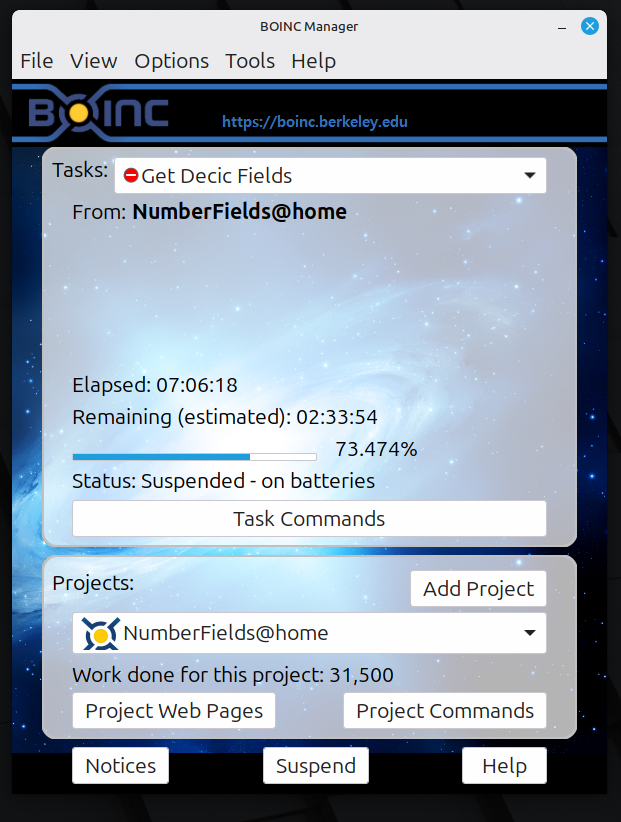
Since there wasn’t work available for any of my usual citizen science computing projects like Rosetta@home, Ramanujan Machine, and World Community Grid, I decided to try contributing elsewhere through BOINC. Letting my system sit idle felt like a waste, so I randomly picked up a work unit from NumberFields@home. It contributes to number theory research including: improvements to algorithms like integer factorization, discrete logarithms and primality testing.
Even with prior experience using BOINC, there was still a learning curve in understanding what this project was/is actually doing. Instead of simulating natural processes like protein folding, epidemiology modeling or
cancer research; it runs large scale mathematical searches. This is something that's much more difficult to visualize, so I ended up reading into it more just to understand what I was supporting; mathematicians mining data for patterns that could reveal new properties in number theory.
What I've learned is that number fields are powerful, as a mathematical framework. According to Wolfram Math World; they extend the rational numbers (ℚ)- all fractions a/b- by adding algebraic elements like √2. This creates a closed system where you are still able to add, subtract, multiply, and divide. The structure produces behavior that can be surprisingly unpredictable, unexpected or erratic; although it's not random but uniform. This is the case, especially when it comes to primes.
The NumberFields@home project description gives a lot of clarity to people who come to the table with little background information. The web page explains that in these systems, primes only appear temperamental but have hidden order. Some split into smaller elements, others stay intact and some undergo more complicated behavior known as ramification. Primality becomes less absolute and more dependent on the structure around it- the underlying ring of integers in the field and this is what leads to deeper theoretical insights.
Despite how abstract the math is compared to something like medical research; the experience and logistics still feel familiar enough to make complete sense of. BOINC makes it fairly easy to contribute CPU and GPU time, running quietly in the backdrop without affecting any active and/ or pending workloads. What hasn't changed is that tasks still have the ability to complete, credits accumulate and even though the objective is different; it’s just as impactful as the other projects I run.
*I'm typing this up at like 4am, so I'm hoping it's follows ok